
 |
 |
 |
 |
 |
 |
 |
 |
 |
Press
Reviews on Art Laboratory Berlin
2020
2019
2018
2017
2016
2015
2014
2013
2012
2011
2007-10
presse@artlaboratory-berlin.org
+49 172 176 5559
Archive
of Press releases and reviews: (click
here)
ART
LABORATORY BERLIN, looking at the past, present, and future of interdisciplinary
art
(Regine
Rapp & Christian de Lutz interviewed by Lyndsey Walsh) in Clot
Magazine, 21 Dec 2020
Current
exhibition:
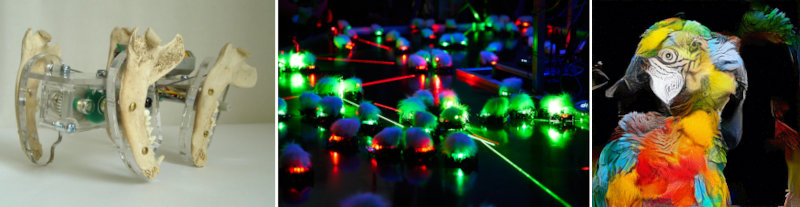
Swarms,
Robots and Postnature
Kaethe Wenzel | So Kanno | Sofia Crespo
Opening on 30 April 2021
30 April 2021 – 27 June 2021
We are pleased to announce that Swarms, Robots and Postnature
will again be open to the public from Friday 21 May 2021 . All guests
must book an appointment in advance. You can book a reservation at https://pretix.eu/artlaboratoryberlin/swarms/
Please note the health regulations below.*
30 April
2021, 8pm - Virtual Vernissage at https://www.facebook.com/ArtLaboratoryBerlin
6 May 2021, 8pm - Online artist talk with So Kanno (https://youtu.be/KLNwbQbdDpM)
20 May 2021, 8pm - Online artist talk with Käthe Wenzel https://www.youtube.com/watch?v=E8pktu7P3ZU
3 June 2021, 8pm - Online artist talk with Sofia Crespo (online
venue TBA)
The exhibition project presents research based artistic positions on swarm
behaviour, questioning the traditional concept of "nature" and
explores the interface of the biological and the machine.
Käthe Wenzel has created interfaces between the biological
and the machine in her project Bone Bots. These hybrid electronic
animals, robots made from animal bones, blur traditional categories of
"technology" and "nature" as they are based on experiments
from synthetic biology and represent semi-living machines. Wenzel's Bone
Costumes thematise the mass consumption of living beings and the daily
killing of animal bodies and the standardized forms into which we try
to squeeze our own bodies. The works emerged from research into historical
corset techniques and in connection with modern fashion technologies;
they have developed into exoskeletons: half organic and half mechanical
apocalyptic outfits.
So Kanno combines design and computer science with digital art
and has been working extensively on robotic systems and swarm robotics
in recent years. Lasermice is a swarm robotics system consisting
of 60 small robots inspired by the synchronous behaviour of insects such
as fireflies. Normally, a swarm's network is invisible, but in this case,
these robots create a visible network using laser-light photodetector
communication. Thus, they create a rhythm, acoustically perceptible through
electronic magnets, that is constantly changing. The updated version
Lasermice Dyad, also follows the idea of making natural phenomena
artificially visible, and features even more parameters.
Sofia Crespo works on the representation of artificial life and
generative forms of life. One of her main focuses is the way organic life
uses artificial mechanisms to simulate itself and to evolve. This implies
the idea that technologies are a distorted product of the organic life
that produced them, rather than a completely separate object. Her Neural
Zoo project is research into how creativity works. Computer vision
and machine learning build a bridge between us and a speculative "nature"
that is only accessible through a high degree of parallel computations.
Curated
by Regine Rapp & Christian de Lutz.
*One
person (+ 1 accompanying from the same household) at a time is allowed
in the exhibition space. As per state health regulations, admission is
subject to proof of a negative SARS-CoV-2 antigen or PCR test result within
24 hours prior to the appointment. FFP2 masks are required for the duration
of the visit. Contact details for all visitors will be retained for one
month. If you have any questions or concerns about these measures please
feel free to contact us before your visit.
With the
generous support of:

Next
exhibition:
Paired
Immunity
Marta de Menezes
& Luís Graça
The exhibition
project
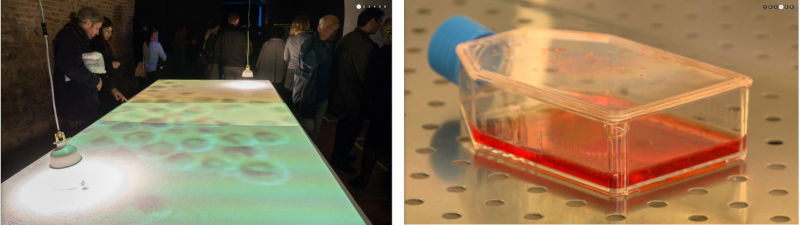
Paired Immunity presents
two works by bio artist Marta de Menezes and her partner, the immunologist
Luís Graça.
In
Immortality for Two Marta de Menezes and Luís Graça
immortalize each other's immune cells. This is achieved by introducing
cancer-inducing genes in the cells with a viral vector. These immortal
cells, although derived from two people in love, are immune cells involved
in the bodily defence. If they interact, they will be mutually rejected.
Thus, immortality comes at a price – perpetual isolation. The live
cells will be exhibited in the absence of any visible lab equipment, and
the tension created by their isolation will be emphasized through two
live projections of the growing cells that partially overlap. Only in
the virtual space of the projection can the cells interact.
The
immune system can be seen as a sixth sense that identifies and discriminates
our composition and the outside world. The work Anti-Marta extends
on Immortality for Two, where the artist and scientist questioned
the limits and understanding of their identity. In Anti-Marta a
skin transplant was exchanged between Marta and Luís (with an autologous
graft as control). Anti-Marta can be seen as a pact, where the
inevitable rejection of the transplant contrasts with the live-long acquisition
of a new form of recognition of one another afforded by the emergence
of antibodies.


Last
Events:
Mind
Blind Pathetic Sublime
Online Performance Lecture by Sarah Hermanutz
16 February 2021, 8 PM
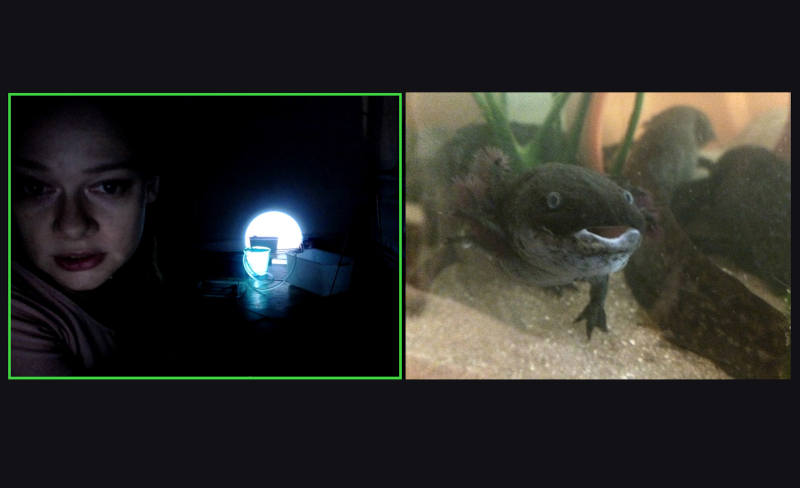
Five years since she presented the lecture-performance Mind
Blind: Therapeutic Interventions for Human/NonHuman Communications
for Transmediale|Vorspiel 2016, artist Sarah Hermanutz revisits the problems
of social cognition in this time of isolation and multiple intersecting
crises.
While previously this performance played with the discomfort and tensions
of an audience's physical presence made captive within the social conventions
of an in-person lecture, in 2021 the human observers may only join remotely
through Zoom. Within the gallery, the artist will livestream from her
unvisitable installation environment. Seeking comfort, escape, and clarity
amid the leaking infrastructures of our times, she will be using whatever
tools at her disposal to finally help axolotls to understand the Pathetic
Sublime.
Registration
required: register@artlaboratory-berlin.org
Organised
by Art Laboratory Berlin in cooperation with Lacuna Lab
This event is part of the Vorspiel Programme of the CTM and transmediale
2021.
VIRAL
CLOUD | Berlin Tokyo
A
Network for Hybrid Arts and DIY Bio Cultures
Since
spring 2020 Art Laboratory Berlin and BioClub
Tokyo have been arranging online meetings between hybrid artists and
associates in our respective cities and beyond. These meetings are a forum
for exchange of research, practice and solidarity in times of crises.
(More
information)
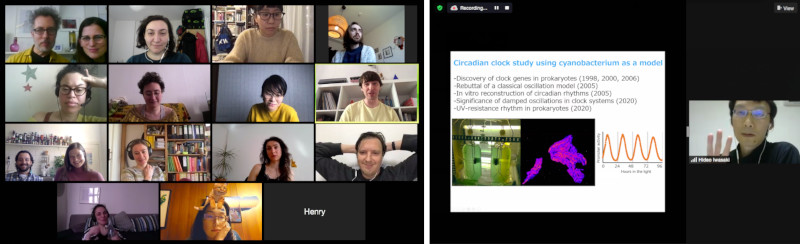
Meeting #13 | 9 February 2021, 1 pm CET/ 9 pm JST
Presentations by Hideo Iwasaki and Matthias Rillig
Hideo Iwasaki is a biologist and artist, director of metaPhorest
(biological art/ bioaesthetics platform), Professor, Department of Electrical
Engineering and Bioscience, Waseda University, Tokyo.
Matthias Rillig is Professor at the Institute of Biology, Plant
Ecologies, FU Berlin. They will speak about their ongoing project
as well as artists in lab, and artist/scientist collaborations.
These events are part of the Vorspiel Programme of the CTM and transmediale
2021.
Last
exhibitions:
Mind
the Fungi | Art & Design Residencies
Theresa
Schubert |
Fara
Peluso
3 July - 28 December 2020
Virtual
opening:
2 July 2020, 6PM via Facebook
Live
Curated by
Regine Rapp and Christian de Lutz
FUTURIUM
| Futurium Lab, Alexanderufer 2, 10117 Berlin
Mon, Wed, Fri, Sat, Sun 10 am – 6 pm, Thu 10 am – 8 pm, Tue
closed, Free entrance
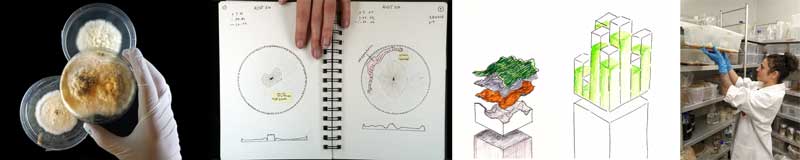
The Artist- and Design-Residencies of Mind the Fungi with
artist Theresa Schubert and artist designer Fara Peluso
bring in art and design as constructive sources of ideas for this research
project. Schubert studied the effects of sound on fungal growth. Peluso
has done research on new biomaterials on the symbiotic basis of algae
and fungi. The artistic and design related works are a result of a close
collaboration with both departments of TU Berlin’s Institute of Biotechnology
– Prof. Vera Meyer’s department of Applied Molecular Microbiology
and Prof. Peter Neubauer’s department Bioprocess Engineering.
(More
information)
With
the generous support of the Technische Universität Berlin as part
of the program Citizen Science - Forschen mit der Gesellschaft:

and

Futurium
Lab und Skywalk wieder offen in Presseportal. de (25.06.2020)
THE
CAMILLE DIARIES.
New Artistic Positions on M/otherhood, Life and Care
Ai
Hasegawa | Baum & Leahy | Cecilia
Jonsson | Margherita Pevere | Mary Maggic
Naja Ryde Ankarfeldt | Nicole Clouston | Sonia Levy |
Špela Petrič | Tarah Rhoda
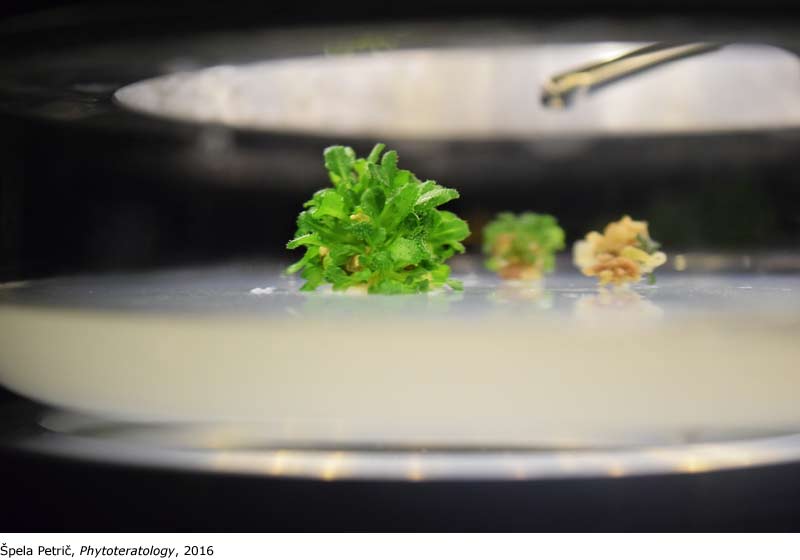
Exhibition
and Symposium | Curated by Regine Rapp and Christian de Lutz
Exhibition
THE CAMILLE DIARIES. Current Artistic Positions
on M/otherhood, Life and Care
Opening:
27 August 2020
Running
time: 28 August - 4 October 2020
@
Art Laboratory Berlin, Prinzenallee 34 | OKK, Prinzenallee 29, 13359 Berlin
Opening Hours: Thu – Sun, 2 – 6 pm
Current
health rules!
The
exhibition presents new artistic works by eleven international women and
non-binary artists (installations, video, objects, performance). Reflecting
on the current conditions of our world (environmental changes, gender
aspects, biopolitics, etc.), the artists' positions propose an 'aesthetics
of care' as the basis for inter-species coexistence. Here, the planet
is understood as a symbiotic web in which we are all entangled with one
another (humans, plants, animals, environment) - on molecular, organic,
ethical and biopolitical levels. The artistic positions investigate reproductive
mechanisms, biochemical connections between humans and nonhumans, and
refer to alternative biomaterials as "source of life" in future
times of scarcity and crisis.
(More information)
Online Symposium
THE
CAMILLE DIARIES
26 September 2020, 10 am – 7:45 pm (CET Time Zone), with livestream
(https://youtu.be/9VAIXGHwj0k)
The one-day symposium will bring the artists together with researchers
from the humanities and natural sciences into a critical dialogue. In
the panels “M/others, wombs and placentas”, “Fluid Inheritance”
and “Modes of care” we will discuss current and alternative
concepts. On the basis of the exhibited works, we will discuss approaches
like "Collective survival" and "Arts of noticing"
(A. Tsing), "Staying with the Trouble" (D. Haraway), and in
particular “Bodies of water” connected to hydrofeminism (A.
Neimanis).
(More information)
Accompanying Talk Show Series
Feminist SF: Visions of M/otherhood &
Reproduction
Curated and hosted by Isabel de Sena
Mary
Maggic | Alison Sperling |
Noemi Yoko Molitor
This event series pays tribute to the powerful alternative images of mothering
we've inherited through the pioneering work of feminist Sci-Fi writers,
and examines their sustained relevance within the socio-political landscape
of today. Through a live Talk Show format artists, scientists and scholars
are invited to programme their "ideal TV and reading evening"
on the topic, so that the audience (re)discovers the works through the
guest's eyes.
(More
information)
Alle
Spezies sind gleich in Art-in-Berlin.de by Urszula Usakowska-Wolff (03.09.2020)
Bio-Art
au Art Laboratory de Berlin by Irina Moussakova in lmoussakova.wordpress.com
(17.09.2020)
A
Scientific Motherhood: ‘The Camille Diaries’ at Art Laboratory
Berlin in berlinartlink.com by Judith Vallette (Sept. 24, 2020)
Insight:
‘THE CAMILLE DIARIES’, finding kin and ‘m/othering’
life In Clot by Lyndsey Walsh (26 Oct. 2020)
ArtHist.net
published on 8 Jan 2021, The Camille Diaries (on the symposium)
With
the generous support of:
Associated
project partners:
The project THE CAMILLE DIARIES arose from a generous invitation to
take part in the international curatorial swarm for the open call »M/others
and Future Humans«, initiated by Ida Bencke (LABAE,Copenhagen, DK)
and Eben Kirksey (Princeton's Institute for Advanced Study, USA).
Media partners:
art-in-berlin.de, www.art-in-berlin.de
AVIVA_Berlin Online Magazin für Frauen, www.aviva-berlin.de
Borderless
Bacteria / Colonialist Cash
Ken Rinaldo
26 January- 1 March 2020, Fri - Sun 2-6PM
Opening 25 January 2020 at 7PM
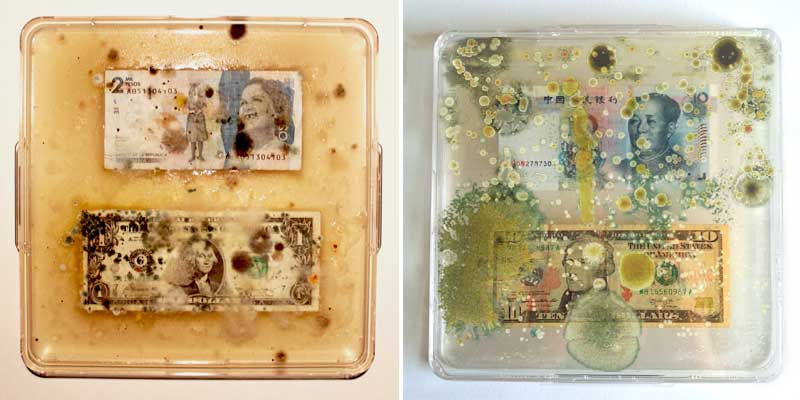
Borderless Bacteria / Colonialist Cash discusses important
current aspects of biopolitics. By visualising microbiome landscapes of
banknotes, the project invites us to reflect about the interconnectedness
of ecological and economic exchanges.
Much recent attention has been given to the human microbiome, the microbes
which live on and within our bodies. These communities also exist on most
surfaces around us. When we touch objects, we exchange bacteria, fungi
and viruses, leaving some microbiota behind. It is no surprise that one
of the objects we touch most – money – is not only a medium
of economic but also microbial exchange. According to a study conducted
by the NYU Center for Genomics & Systems Biology, 3000 types of bacteria
were identified on dollar bills from just one Manhattan bank.
Ken
Rinaldo, an established artist in the field of Bio and Postmedia art,
develops hybrid human-nonhuman ecologies. Borderless Bacteria / Colonialist
Cash explores the hidden microbiome of money within a critical framework
that also sheds light on exchange and power. Do Chinese Yuan and American
Dollars share bacterial and fungal communities?
This
micro-performative project is intriguingly simple in its setup: Various
bills of international currency are displayed in square Petri dishes on
enriched agar. Time plays a crucial role, as a microbial landscape grows
and realises itself over the course of several weeks.
On
an aesthetic level, the iconography of the currency literally loses face
as microbial growth undermines the representational aspect of the banknotes.
The official character of money is subverted. As its microbial nature
comes to light, it appears far less representative: a fine network of
mycelia covers the head of George Washington on a $1 note; on a 10 CHF
note, Le Corbusier is no longer recognisable due to bacterial growth.
Wishing
to lessen his carbon footprint, artist Ken Rinaldo expressed the wish
that the work be made without his travelling. This work was first made
in 2017 during a residency at Cultivamos Cultura, Portugal. Some of the
works in the exhibition were created with students from the Gustav-Freytag-Schule
in Berlin-Reinickendorf as part of a collaboration between the school,
ALB and the DIY Hack the Panke collective.
(More information)
Regine Rapp
and Christian de Lutz (curators)
Exhibition
text as .pdf
Art-in-Berlin,
Finis Pecunia! Viva Mycelia!, published on 24. February 2020 by
Urszula Usakowska-Wolff,
https://www.art-in-berlin.de/incbmeld.php?id=5287
KUNSTDUNST. das Kunstmagazin aus Berlin. Finis Pecunia! Viva Mycelia!
– »Borderless Bacteria / Colonialist Cash« von Ken Rinaldo
im Art Laboratory Berlin, published on 24. February 2020 by Urszula
Usakowska-Wolff,
https://www.kunstdunst.com/finis-pecunia-viva-mycelia-borderless-bacteria-colonialist-cash-von-ken-rinaldo-im-art-laboratory-berlin/
El Pais, MICROBIOLOGÍA. Los billetes concentran hasta 3.000
tipos de microbios ,
published on 24 January2020 by Agathe Cortes
https://elpais.com/elpais/2020/01/22/ciencia/1579714580_913085.html
Wiederveröffentlichung:
https://brasil.elpais.com/ciencia/2020-01-25/notas-concentram-ate-3000-tipos-de-microbios.html
https://www.mediotiempo.com/otros-mundos/billetes-3-mil-bacterias-mayoria-boca-vagina
https://www.razon.com.mx/virales/bacterias-de-los-billetes-provienen-de-boca-y-genitales-revela-estudio/
https://www.primicias.ec/noticias/tecnologia/bacterias-billetes-arte/
https://www.elespectador.com/noticias/ciencia/los-billetes-pueden-contener-hasta-3000-tipos-de-microbios-articulo-901707/
https://expreso.press/2020/02/01/bacterias-genitales-las-mas-frecuentes-en-los-billetes/
https://www.elsoldepuebla.com.mx/doble-via/ciencia/fotos-bacterias-genitales-en-los-billetes-esto-revelo-un-estudio-4839524.html
https://ladiaria.com.uy/articulo/2020/5/mas-alla-del-credito-y-el-debito-aplicaciones-de-dinero-electronico-en-uruguay-y-el-mundo/
New Scientist, Contaminated banknote images reveal how money gets caked
in bacteria
Life, published on 15 January 2020 by Bethan Ackerley
https://www.newscientist.com/article/mg24532653-000-contaminated-banknote-images-reveal-how-money-gets-caked-in-bacteria/
Part of
the Vorspiel programme in partnership with the CTM and transmediale
With the
generous support of:

Thanks
to Cultivamos Cultura | Marta De Menezes and Dr Luís Graça;
Dr. Mario Ramirez, Molecular Microbiology
& Infection, Instituto de Medicina Molecular in Lisbon, Portugal;
Prof. Amy Youngs; Dr. Adam Zaretsky.
Previous
Events:
Discussion
and Livestream
A
Future for Food
with
Amy Youngs, Ken Rinaldo, Anna Paltseva, Daniel Lammel,
Regine Rapp and Christian de Lutz
4
June 2020, 4-6 pm CET / 10-12 am EST
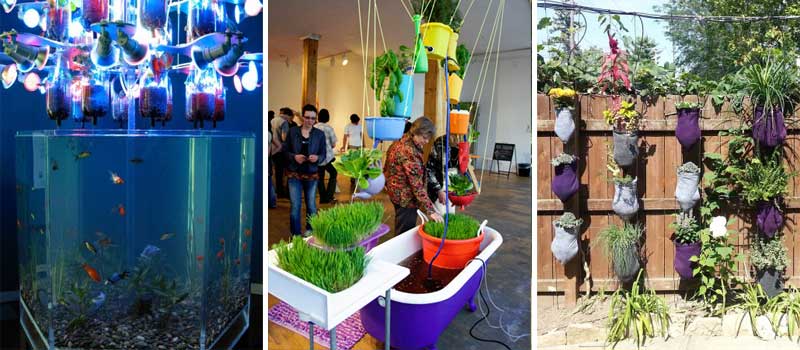
Left: Ken Rinaldo & Amy Youngs, Farm Fountain, 2009; center: Amy Youngs, Building a Rainbow, 2011; right: Ken Rinaldo, Cascading Garden, 2014
Can we break away from current agricultural practices which are intimately connected to desertification, water and soil pollution, antibiotic resistance, climate change and social and economic inequalities? In a two-hour discussion we are interested in considering a sustainable, multispecies perspective to farming, which could start in the soil and progress through thinking about the multiple ways we can consider food. Aquaponics, vertical farming, worms, soldier flies, and permaculture offer real solutions, where food is grown while respecting living beings, and the intertwined ecologies that support them.
Humane food can be grown in urban or rural communities, though the soil is critical. How can we learn and care about living beings we cannot quickly know or see? What is care like in practice? We are also interested in exploring the concept of "citizen eco-artist" as so much of what we do resides in the spaces between actual science, sustainable practice and speculative fiction.
This international talk with be livestreamed on youtube and here and questions can be sent in comments via youtube, facebook or query@artlaboratory-berlin.org
Speakers:
Amy Youngs is an Associate Professor in art and technology at Ohio State University. She uses electronics, kinetics, insects, plants and pixels to create artwork about the changing relationships between technology, nature and self. Her work has been exhibited nationally and internationally and her essays about art and biology have been published in Leonardo and Nouvel Objet.
Ken Rinaldo is internationally recognized for interactive art installations developing hybrid ecologies with humans, algorithms, plants, animals, and bacterial cultures. His art/science practice serves as a platform for hacking complex social, biological, and machine symbionts. Inventing and constructing interfaces for animals and plants, allows illuminating and amplifying the underlying beauty, and intertwined symbiosis existent in natural living systems. Rinaldo is author of Interactive Electronics for Artists and Inventors, and is a Professor of Art and Technology at The Ohio State University.
Anna Paltseva holds a Ph.D. in Earth & Environmental Sciences at the CUNY Graduate Center and Research and Program Coordinator at the NYC Urban Soils Institute. She focuses on the assessment of heavy metals bioavailability in urban soils. Anna Paltseva is a lecturer at CUNY – Brooklyn College, New York University, and the New York and Brooklyn Botanical Gardens. Anna develops educational materials, leads soil workshops and coordinates collaborations with international researchers for the NYC Urban Soils Institute.
Daniel Lammel is a Postdoctoral researcher at the Institute of Biology (Ecology of Plants), Free University Berlin. His areas of research is soil ecology and mycorrizal symbiosis as well as Soil Fertility, Plant Nutrition, Agricultural Science and Ecosystem Ecology. Originally from Brazil, he studied at the university of São Paulo, before competing his Ph.D. at Univ. of Massachusetts in Amherst.
Regine Rapp is an art historian, curator and co-director of Art Laboratory Berlin. Her current research interests include Installation art, artist books, hybrid art, art & science collaborations. She researches, curates and publishes on 21st century art at the interface of science and technology. She has taught art history at the Burg Giebichenstein Kunsthochschule Halle and is currently a researcher at the TU Berlin Institute of Biotechnolgy, Dept. for Applied and Molecular Microbiology.
Christian de Lutz is a curator, co-founder and co-director of Art Laboratory Berlin, where he has curated over 40 exhibitions, including the series Time and Technology, Synaesthesia, [macro]biologies & [micro]biologies, and Nonhuman Subjectivities. His curatorial work focuses on the interface of art, science and technology in the 21st century, with special attention given to BioArt, DIY Science initiatives and facilitating collaborations between artists and scientists.
A coproduction of the Network for Prototyping the Future and Art Laboratory Berlin
Discussion
Workshop and Livestream:
Mind
the Fungi
MATERIAL
DRIVEN DESIGN. Sculpting with Bioplastic Textile
Workshop/
Livestream with Fara Peluso
6
May, 2020 6-8PM
Today Material Research is a central point in the theory and practice
of designing new technologies, in cooperation with art and design. These
fields are currently collaborating, merging their knowledge and practice
to develop a new generation of materials, by focusing on specific characteristics,
to create new environmentally friendly materials. Another approach, however,
has also arisen in the last years combining making, crafting and personal
fabrication of new materials through a form of Do It Yourself (DIY) biology
and craftmaking.
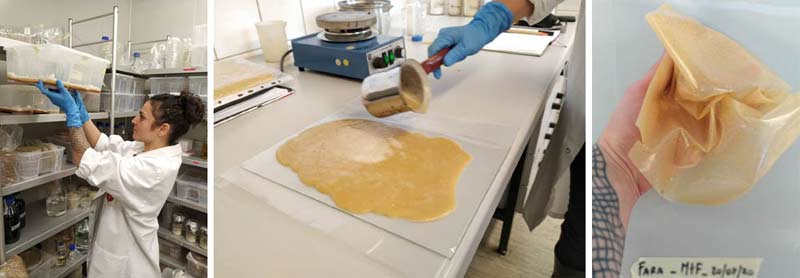
This Mind the Fungi workshop discusses this new material driven
design movement and methodology, learning how to build a new material
by studying and using a living organism like mycelium. Discovering the
features, possibilities and limits of mycelium-based materials, the participants
will work together growing material and developing new material, building
sculptures, assembling DIY packaging and drawing and cutting patterns
on a new material made of biofilm.
Due to the COVID-19 crisis the initial workshop has been postponed
and will hopefully take place later this year.
On 6 May a livestream talk and workshop with Fara Peluso took place. More
here.
Day 1
After an introduction by Fara Peluso into her design research and
insights by the biotechnologists from TU Berlin in context of the project
Mind the Fungi, the participants will learn how to inoculate mycelium
into a liquid culture and prepare a biofilm based on mycelium and algae.
The knowledge and techniques learned are functional in a DIY setting.
Day 2
After a two-week period, during which the biofilms will grow, the
participants will be now able to use their new biomaterials to assemble
sculptures or create designed objects like bags. Here innovative design
practice will enable us to unleash the potential of these new materials
created through material driven design.
Fara Peluso, a Berlin based artist-designer, graduated
in industrial design and graphic design at University of Spienza, Deptm.
for Architecture, Rome. Through speculative research her work connects
the human being with nature, living organisms and biological processes
to form a deeper relationship. Together with biologists, she has pursued
deep research into algae, taking constantly inspiration from them, experimenting
and understanding how to work with them inside the fields of Art and Design.
In collaboration with BioArt Laboratories in Eindhoven, she developed
the prototyping of a speculative wearable accessory, WeaReactor, which
connects the algae's photosynthesis process with the breath of the wearer
(exhibited at DDW17 in Eindhoven in 2017; at Art Laboratory Berlin in
2019). Peluso has extended this knowledge over the last 15 months by working
with researchers at the TU Berlin Institute of Biotechnology on mycelium-based
materials as an artist-designer-in-residence in the project Mind the Fungi.
Mind
the Fungi (2018-20) is
a collaborative project between the Institute of Biotechnology TU Berlin
and Art Laboratory Berlin. Biotechnologists and process engineers are
researching local tree fungi and lichens (Prof. Vera Meyer/ Applied Molecular
Microbiology; Prof. Peter Neubauer / Bioprocess Engineering). The focus
is on developing new ideas and technologies for fungal and lichen based
materials for the future. Art Laboratory Berlin bridges the gap between
science, art, design and the public and offers various Citizen Science
formats. The Artist- and Design-Residencies with Fara Peluso and Theresa
Schubert bring in art and design as constructive sources of ideas for
this research project.
(More
information)
With the
generous support of the Technische Universität Berlin as part of
the program Citizen Science - Forschen mit der Gesellschaft:
Discussion
Workshop and Livestream:
DIY
Hack the Panke
Microplastics
and Coexistence
Kat
Austen and Nana MacLean
Wednesday
22 April 2020 from 5:30-7:00 pm
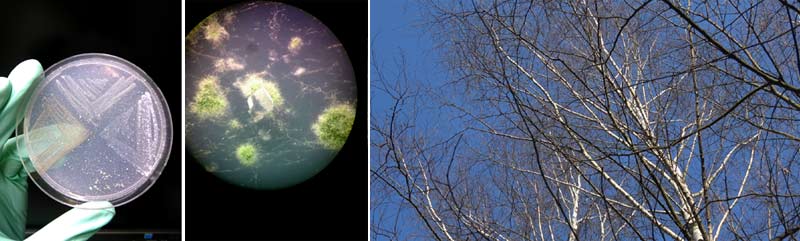
What we consider
to be our environment unequivocally and ubiquitously contains plastic.
It has been found at the outskirts of human reach: at the top of Mount
Everest, in Arctic ice, and at the bottom of the Mariana trench. Plastic
is becoming part of our geology and the lively surrounding of many organisms
on this planet - a new material and habitat providing new stories and
lifeforms.
Coexistence of plastic with non-artificial entities in the environment,
and with humans, is a burgeoning area of research, which has been explored
through participatory interdisciplinary techniques. In the DIY Hack
the Panke programme's (Un)Real Ecologies workshops by Nana
MacLean and Kat Austen, participants worked together to research the coexistence
of microplastic with the Panke River in Berlin-Wedding. The Sushi Roulette
workshop series uses DIY chemistry to search for microplastics in fish
guts.
While plastic can be detrimental to the quality of an ecosystem, plastic
pollution is also a carbon sink, storing carbon and keeping carbon dioxide
and methane out of the atmosphere. But is this carbon sink, itself an
embodiment of industrial processes that contribute to the climate crisis,
in competition or complementarity to forests? Using DIY science and artistic
research, Kat Austen has been working on a new project exploring the coexistence
of microplastics with birch trees for her project Stranger to the Trees*
.
This Earth Day, join Kat Austen and Nana MacLean to discuss the coexistence
of microplastics in the environment and what it means for nature and ourselves.
More information and video documentation
Kat Austen is a succession of experiences and an assemblage
of aspirations. She creates artworks that explore multiple knowledges,
from music to embodied knowledge to DIY science, focusing on emotional
connections between what we consider internal and external. Kat is Cultural
Fellow in Art and Science at the University of Leeds, lectures on UCL's
Arts and Sciences BASc, and is Artist in Residence in UCL's Faculty of
Maths and Physical Sciences. Previous residencies include NYU Shanghai
Gallery and ArtOxygen. Kat was an inaugural member of the London Creative
Network programme. She is based in Berlin.
Joana
MacLean studied Biology at the UvA Amsterdam and finished her Master
studies in Molecular Biology at the University Potsdam. Besides her studies,
she has been involved in projects that crossed borders between disciplinary
styles and methods - embracing both speculative design and performative
collaborations. As a PhD student, Nana is currently working on microbial
communities in anthropogenic landscapes and plastic polluted grounds at
the GFZ Helmholtz Center Potsdam. Her research focuses on Plastic as biological
habitat, and furthermore explores future ecologies and areas of research
that involve storytelling and other imaginative methodologies. Nana is
based in Potsdam and Berlin.
Supported
by the Berlin State office for Culture and Europe:

Special
thanks to Ken Rinaldo
Cooperation
partners:
https://plastisphere.hotglue.me
*Stranger
to the Trees is realised within the framework of the European Media Art
Platforms EMARE program at WRO Art Center with support of the Creative
Europe Culture Programme of the European Union"

Previous
exhibitions and events: (click here)
Information on the Mind the Fungi project here
Information
on DIY Hack the Panke here
Information on the Nonhuman
Agents series from 2017 here
Information on the Nonhuman
Subjectivities series
from 2016-17 here
Information on the [macro]biologies
& [micro]biologies series
from 2014-15 here
Publications!
[macro]biologies & [micro]biologies. Art
and the Biological Sublime in the 21st Century. Ed. by
Regine Rapp & Christian de Lutz, Berlin 2015. More
information
Press
release as .pdf
Online
Publication:
We
are proud to share with you our online-publication of the international
interdisciplinary 2-day SYNAESTHESIA-Conference, held by Art Laboratory
Berlin in the summer 2013:
Synaesthesia. Discussing
a Phenomenon in the Arts, Humanities and (Neuro-)Science
Information
about Art Laboratory Berlin:
Art
Laboratory Berlin (as.PDF)
If you have any questions or wish material about the exhibition, please
contact
presse@artlaboratory-berlin.org
| Sponsored by: | ||||||
 |
 |
|||||